Is This AI?
There is a fun game on Reddit called IsThisAI? Users post images and videos of things they suspect of being artificially generated and the hive mind of Reddit decides whether it is or isn’t AI, as well as giving justification on one way or the other. Users point to mangled hands, blurry text, impossible lighting as well as other subjective criteria as evidence. The subreddit is a good bellwether on how far we have progressed from the nightmare inducing Will Smith Eats Spaghetti AI generated video. Things are getting better and AI much more difficult to spot.

This month saw the coming into effect of the EU AI Act, a far reaching piece of legislation that is aimed at regulating and putting some structure on how data is generated by GenAI applications within the EU. It sees an AI Transparency condition that mandates that AI generated content must be flagged as such. Failure to comply may result in hefty fines. Suddenly the game of IsThisAI has stopped being a game and now has real world consequences.
GenAI providers must have an objective way of stamping the media they create. Subjective criteria such as impossible appendages and lighting is not good enough. Methods must also be tamperproof. A watermark in the bottom corner of an image can be simply cropped out of a photograph. Video editing software can easily edit out video watermarks. And what about Textual content? OpenAI, Anthropic, Google and others have all signed up to the challenge.
There are two complementary methods that are emerging as the methods of choice for identification markers: C2PA and SynthID. Both of these methods rely on embedding identifying information within the generated content although they vary in their application.
C2PA
C2PA or the Coalition for Content Provenance and Authenticity, is a standard for documents to carry a cryptographic signature that verifies where and how a file was created. It functions much like a hash function in that if anything is modified in that file, the function value changes and therefore shows that the document has been tampered with. The C2PA standard provides an open framework that any content creator, not just GenAI providers, can use to sign their documents. It has been adopted by Adobe, Microsoft, the BBC as well as GenAI providers as a method of signing their creations.
How it works
C2PA is based on the manifest (also known as a Content Credential); a block of binary data saved beside the file’s content that stores assertions, facts and declarations on the files provenance. It is cryptographically signed by a verifiable identity. For example, a C2PA compliant tool such as Adobe Lightroom, will save an image, create a manifest within specifying how and when it was created, then sign it using Adobe’s trusted C2PA signature. Any other C2PA compliant tools that modify the file subsequently will add their own manifest, creating a chain of custody of evidence.
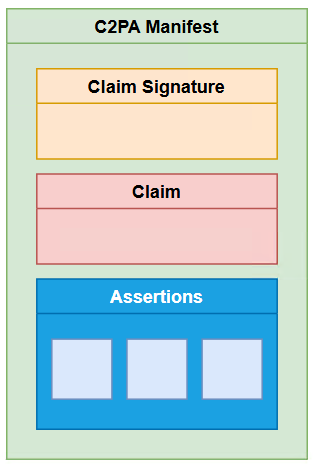
The framework is very much similar to EXIF metadata in photographs. Both are additional metadata containers sitting alongside the pixels in an image. While EXIF records the make and model of a camera that took the photo, C2PA records where the file came from and what was done to it. EXIF metadata is editable and can easily be removed while C2PA is not visible and is meant to be a living tamper proof record of the documents provenance. Change the images content and the C2PA makes the tampering obvious.
Adoption
A standard is only as good as its adoption! Fortunately for the C2PA, it is being pushed by a large and varied number of corporations and is widely been seen as a quick and easy way to satisfy authenticity requirements. As of January 2026, the C2PA has over 6000 partners and affiliates who are implementing or detecting the C2PA in files. This is not just used for GenAI but GenAI is a great use case where you need to address authenticity. To check C2PA content of any file simply head on over to https://www.c2paviewer.com and drop in your file for the C2PA to be extracted.
The C2PA framework is not a complete solution to the authenticity question however. It has a number of problems. For one, it is an open standard that relies on voluntary adoption and honest use. There is nothing preventing false data being entered into manifest!
Secondly it can easily be stripped out. The metadata block that stores the manifest can simply be removed. Worse still, you can simply take a screenshot of the image and the C2PA will be gone. Some social media sites even strip out all metadata as part of the media upload process.
As a result, although it is a great initiative, C2PA alone is not enough in guaranteeing the provenance of a file. For that we would need something more advanced.
SynthID
SynthID is a system developed by Google’s DeepMind to specifically identify content generated by LLMs. When an LLM generates data, SynthID embeds markers directly into the content in a statistically indefiable but imperceptible way. It differs from the C2PA as it cannot be easily stripped out and has been tested to resist image cropping, lossless compression, even screenshotting. Since its release in 2024 it has been quickly adopted by GenAI and is beginning to feel like the defacto standard in identifying GenAI content.
How it Works
The SynthID system is a composed of two parts or models, the first model (the embedder) makes the changes and the second (the detector) analyzes the content to identify the patterns. Because they were developed together they know what the other does and therefore know what to look for and where. Take an image for example. Its made up of pixels each with a RGB value in the 0-255 range. Pure red is (255,0,0). SynthID may adjust this value of some of the pixels to (254,0,0). To humans this is still red, but not to computers. Do this enough in a specific way across the entire image and a pattern starts to emerge.
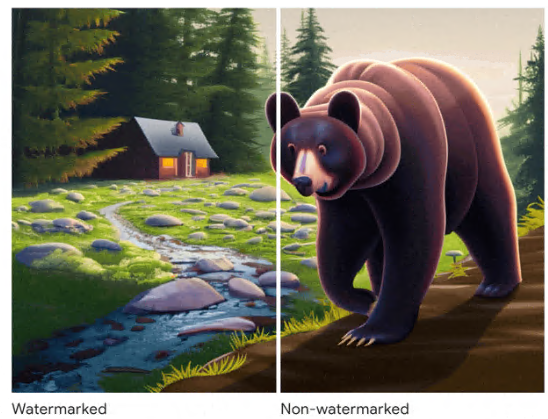
SynthID takes advantage of the fact that human perception is imperfect. Its a form of steganography that finds hiding places in the content in which to place its markers. The hiding place depends entirely on the medium that it is working in. For images and videos changes are made to the pixel values. For audio, changes are added to audio wavelengths that cannot be heard by human ears. For text? This is where things get a little interesting.
Text SynthID takes advantage of how LLMs generate prose. The language model constructs sentences by picking the most likely next word one after another. SynthID adjusts the probability of one word being picked over another to create a statistically identifiable signature. Take the sentence “The weather today was cold and…”. The LLM has two very likely next words “grey” or “overcast”. To humans, it does not really matter which word is used because the meaning is the same. In this scenario, the LLM will usually pick one word at random. But in the same way as the slight change in RGB value creates a pattern, in these low stakes decisions, SynthID adjusts the weights of the choices to favour one of the two. Compare the SynthID text and the text that you would have created if the choice was purely random and you can uncover the probability that there is a SynthID modification.
There is a lot more nuance to it. SynthID is tuned to individual media types. In all cases where SynthID is used however, it is meant to be invisible and does not change or alter the quality of the end product.
Adoption
SynthID has quickly grown to be a standard in the LLM industry. OpenAI, Anthropic as well as Google have adopted the process in their generating software. Google is continuing the development of the system. SynthID for text was only released recently.
Its not fool proof. It can be removed with difficulty. Heavy cropping of an image or video, extreme upscaling and other manipulation could make it harder to detect the watermark. SynthID text can be diluted by human edits and outright does not work if exact precision is required. Code or situations where 2 + 2 = ? don’t provide any room to add in randomness. The answer is always going to be 4 and code will have to be exact to work. This is why SynthID is a probabilistic score. It can only tell you the likelihood that a piece of media is generated by AI, not that it definitely has been.
Google’s Gemini has the ability to check for SynthID and is opening up a SynthID Detector portal soon. Anthropic is also creating a portal while OpenAI’s Verify system is already live.
Meta has to be difficult. It does not use SynthID and launched its own Content Seal system in July 2026 instead.
Summary
There are of course, a lot of other different ways that one can spot AI fakes. The more we are exposed to LLM AI Slop the more easily these fakes are identified. We are asked to look for imperfect symmetry for GenAI images, GenAI videos that have lots of cuts or are suspiciously short, or GenAI prose that has that annoying habit of adding that “Not this but that” pattern. Seriously, once you notice its hard to ignore. There is no depth, no variation, just the same repeating pattern.
That is why the IsThisAI game is so interesting. Overtime it teaches one what to look out for as well as revealing how far we have come. Recently, however, the top comment is always “SynthID found. Its fake” or “C2PA says it was created by OpenAI”. It makes the game a little less fun but at least shows that the EU Commission regulations is having an effect.
Photograph: The Milkmaid
Photographer: Jeroen Nieuwhuis

Damir Kahvedžić
Damir Kahvedžić is a technology expert specializing in providing clients with technical assistance in eDiscovery and Forensics cases. He has a PhD in Cybercrime and Digital Forensics Investigations from the Centre for Cybercrime Investigation in UCD and holds a first-class Honours B.Sc in Computer Science. Experienced in the use of industry leading software, such as Relativity, EnCase, NUIX, Cellebrite, Clearwell, and Brainspace, Damir is also a PRINCE2 and PECB ISO 21500 qualified project manager.
Damir has published both academic and technical papers at several international conferences and journals including the European Academy of Law, Digital Forensic Research Workshop (DFRWS), Journal of Digital Forensics and Law amongst others.